
How E Living Furniture unified five platforms into one BigQuery warehouse
A fast-growing home furniture ecommerce brand replaced scattered spreadsheets and siloed tools with a Fivetran + BigQuery data stack - cutting reporting cycles from days to minutes and automating a discount engine that lifted clearance efficiency by 22%.
Outcomes
How E Living Furniture unified five platforms into one BigQuery warehouse
Who they are
E Living Furniture is a fast-growing home furniture ecommerce brand running paid acquisition across Meta and Google, selling through Shopify, and managing physical inventory in CIN7. By the time the business had scaled past a handful of SKUs and a single country, the operating team was working from five different dashboards that did not agree with each other.
The problem
The symptoms were familiar. Every department had its own source of truth:
- Marketing lived in Meta Ads Manager and Google Ads - two different ROAS numbers, two different attribution windows.
- Sales lived in Shopify - accurate on revenue, blind on ad spend.
- Operations lived in CIN7 - accurate on stock levels, blind on velocity.
- Leadership lived in a patchwork of spreadsheets that nobody fully trusted.
Weekly reporting was a manual reconciliation job. By the time someone had stitched spend, revenue, margin, and inventory into one view, the data was already three days stale. Discount decisions happened by feel, not by data - slow-moving stock sat on shelves while fresh inventory kept landing.
The business was ready to scale paid spend, but nobody wanted to commit more budget to channels they could not measure end-to-end.
What we shipped
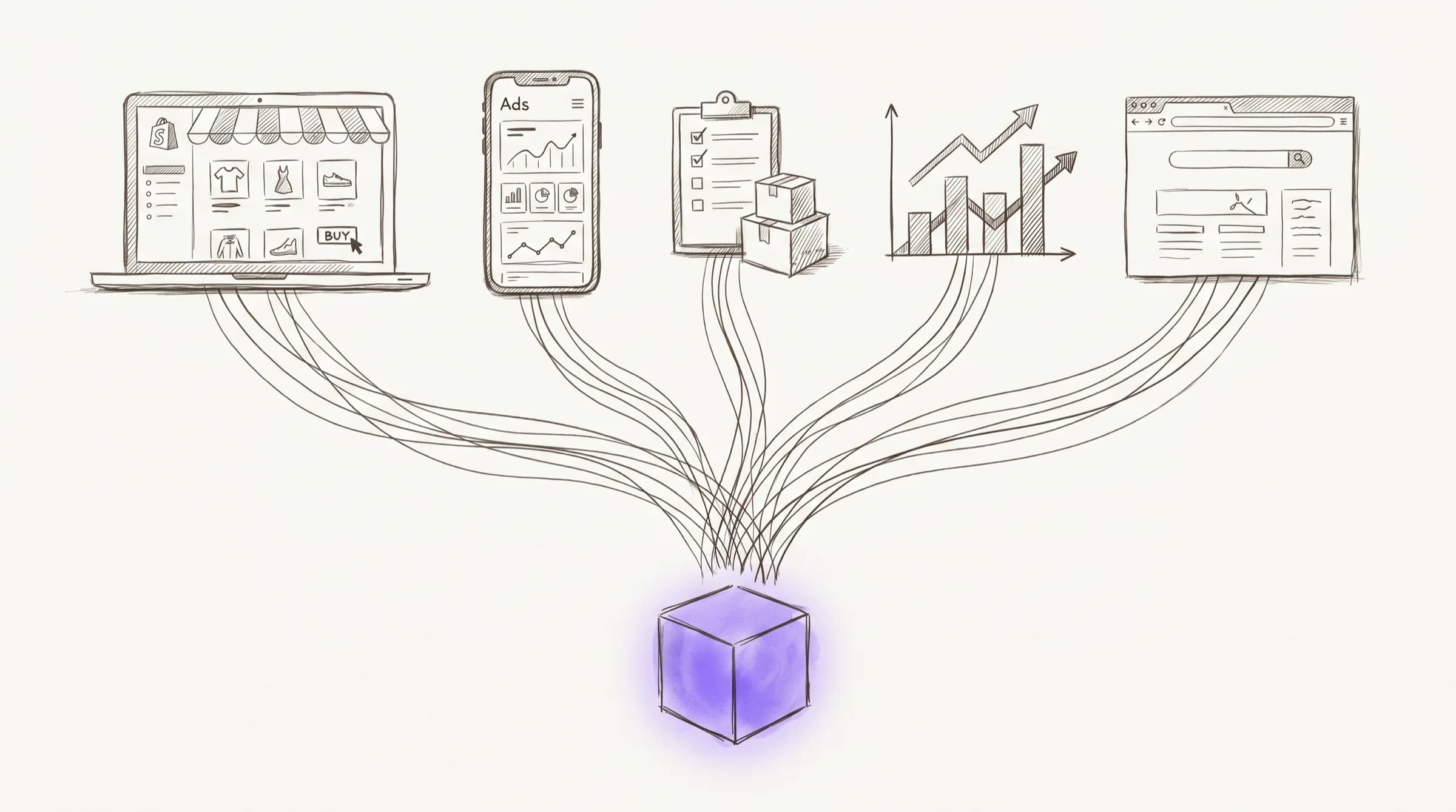
Over roughly four weeks, Anlyto delivered a unified, automated data pipeline. Every downstream dashboard, alert, and automation reads from one place: a Google BigQuery warehouse.
Source connections via Fivetran
Fivetran handled the extract and load layer across every platform in the stack:
- Shopify - orders, products, customers, refunds
- CIN7 - inventory positions, stock movements, product availability
- Facebook Ads - spend, impressions, conversions, creative-level ROAS
- Google Ads - paid search and display performance, offline conversion imports
- Google Analytics 4 - on-site behaviour, conversion events, traffic source attribution
Connectors run on scheduled syncs into BigQuery. No manual imports, no one-off CSV downloads, no Monday-morning spreadsheet rebuilds.
Modelled in BigQuery
Raw source tables land untouched in one dataset. A staging layer normalises names, types, timezones, and currency. A mart layer combines them into business-facing tables:
- Daily channel performance - spend, revenue, margin, blended ROAS per channel per day
- SKU velocity - units sold, days-of-supply remaining, contribution to revenue
- Funnel attribution - GA4 behaviour joined to Shopify orders on a deterministic session key
- Ad creative performance - Meta and Google ad-level metrics joined to landing-page and purchase events
Every dashboard reads from marts. Every ad-hoc query reads from staging. Nobody reads from raw except when debugging a connector.
Looker Studio dashboards
One executive dashboard covers the whole business:
- Unified performance overview across sales, inventory, and ad spend
- Dynamic filters by date range, product category, and traffic source
- Live KPIs updated daily - no overnight batch jobs that quietly fail
- Scheduled email digests for the founder and ops lead
The dashboard is what the founder opens first thing in the morning. If it takes longer than two seconds to load or needs interpretation, it has already failed at its job.
Automated discount engine via Make
The most interesting piece sits on top of the warehouse. We built a rule-based discount engine in Make that reads directly from BigQuery every day:
- Query inventory turnover from the CIN7 tables in BigQuery
- Cross-reference with product views and conversion rates from GA4 and Shopify
- Pull ad performance from Facebook and Google Ads to understand demand signal
- Apply a configurable rule set - SKUs below velocity threshold and above stock-cover threshold get discounted
- Push the new pricing directly to Shopify via its Admin API
The whole loop runs daily. Slow-moving inventory now marks itself down without anyone touching a product page. The rule thresholds sit in a Google Sheet the ops team can edit without redeploying anything.
The numbers
Measured 90 days after the stack was in place, baselined against the prior six months of manual reporting:
- 100% automated data sync - zero manual data wrangling across five platforms (Shopify, Klaviyo, Recharge, Meta Ads, Google Ads).
- 90% faster reporting - the weekly executive numbers went from a 2-day spreadsheet rebuild to an 8-minute Looker Studio refresh.
- 22% lift in clearance efficiency - measured as units sold per week of clearance-tagged SKUs, comparing the 60 days before and after the discount engine went live, holding catalog mix and traffic constant.
- One source of truth - leadership, marketing, and operations now debate strategy, not whose spreadsheet is right.
The secondary impact was harder to quantify but more important. With reporting automated, the team spent the reclaimed hours on things that actually grow the business - new creative, new products, new markets - instead of rebuilding the same dashboard every Monday.
What mattered most
Three design choices carried most of the weight:
- Treat the warehouse as a product, not a side project. Raw, staging, marts - clear boundaries, consistent naming, documented ownership. The moment the warehouse becomes a sandbox, trust erodes and people quietly go back to their own spreadsheets.
- Make inventory a marketing metric. Pricing and ad spend should see stock. A winning creative that sells out in four days is not a win if you cannot restock in two weeks.
- Automate the boring decisions, keep humans on the creative ones. The discount engine is a rule set, not an AI. Ops still tunes the rules. But nobody manually marks down 400 SKUs every Monday anymore.
What a stack like this unlocks
Once the pipes are in place, the rest is cheap. Adding a new ad platform is a Fivetran connector, a staging model, and a dashboard panel. Adding a new automation is a Make scenario reading from an already-modelled BigQuery view. The expensive part is the first pass. Everything after compounds.
For E Living, the end state is not just better reporting. It is a business that can scale ad spend and SKU count without adding headcount to keep the numbers honest. That is what a modern ecommerce data stack is actually for.
Anlyto services that built this engagement:
- Marketing Analytics - multi-channel attribution and ad-platform conversion sync.
- Looker Studio Dashboards - the executive and operational dashboards on top of BigQuery.
- Product Analytics - the event taxonomy and funnel work that connected ad spend to in-store behavior.
Read more: The ecommerce marketing data stack - the field guide that describes the architecture used here.
Want a case study that looks like this - for your clients?
Book a 30-minute discovery call. We'll sketch the engagement and send a fixed quote inside two business days.